
When people think about choosing a large painting, they often begin with the dimensions of an empty wall. How much space is there? How large a painting will fit?
Those are useful questions—but they are not necessarily the most important ones.
A large-scale painting does more than fill an empty wall. It can establish a focal point, influence how the eye moves through a room, bring warmth or energy into an interior, and even change how we experience the architecture itself.
The question, then, isn't simply “Will it fit?”
It is: “What do I want this painting to do for the room?”
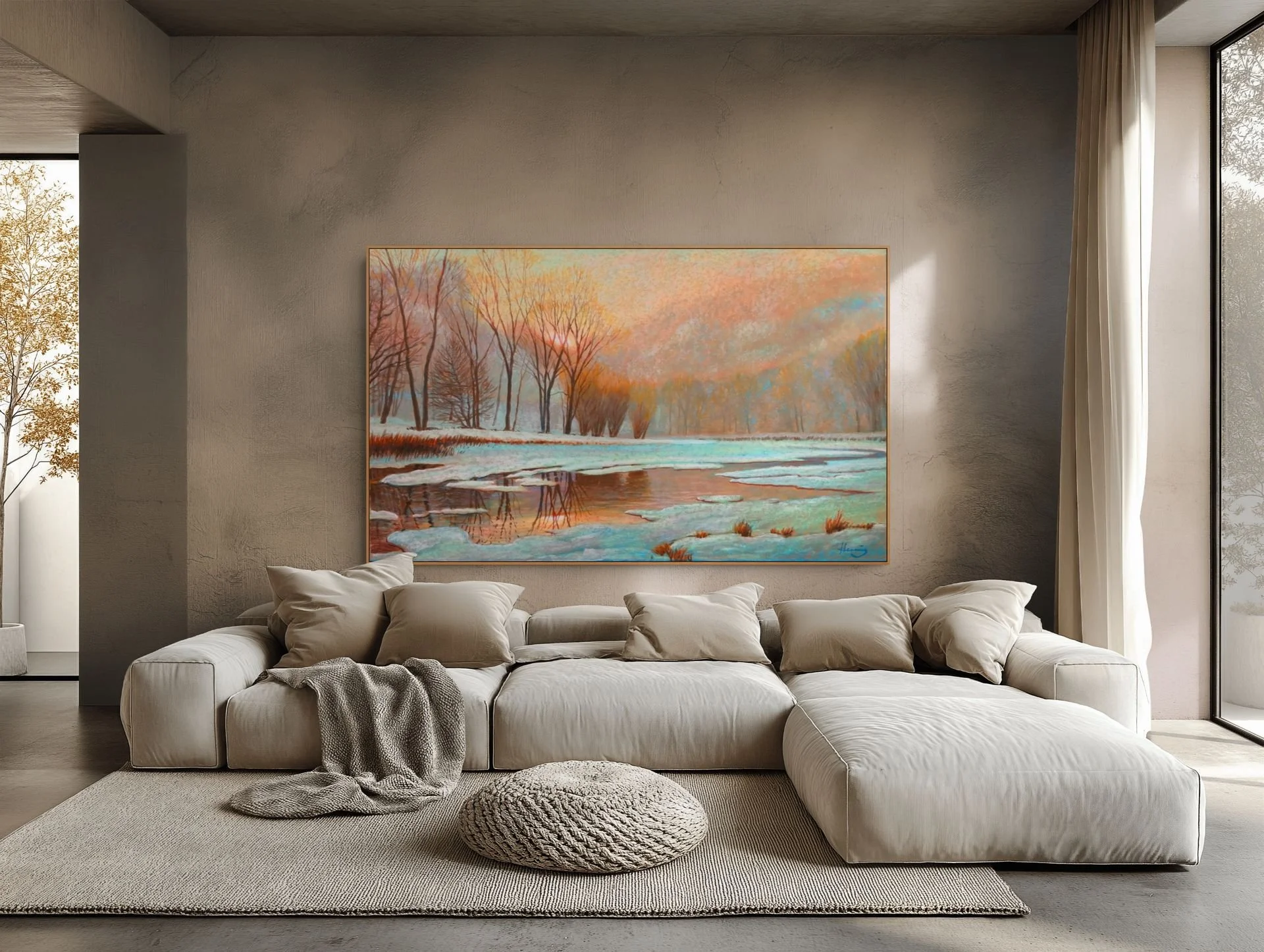
Spring Thaw demonstrates how a large-scale landscape can anchor a room while bringing color, depth and a sense of openness to the space.
Begin With Presence, Not Measurements
Of course, scale matters. A painting needs enough room around it to breathe, and its proportions should make sense in relation to the wall, furniture, and architectural features surrounding it.
But before reaching for the tape measure, consider the feeling you want when you enter the room.
Should the painting command attention immediately? Should it create a sense of calm? Add warmth to a minimalist interior? Introduce color into a neutral space? Or perhaps create a visual destination that draws you farther into the room?
Large paintings have presence. Choosing one successfully is as much about deciding what kind of presence you want as it is about choosing the correct dimensions.
Consider the Painting From Across the Room
One of the advantages of a large-scale painting is that it doesn't need to be experienced only from directly in front of it.
Think about the different places from which you will see the painting.
Perhaps it is visible from an adjoining room. Maybe you will see it while sitting on a sofa, entering through a doorway, walking down a hallway, or preparing dinner in the kitchen.
These longer sight lines can be especially important in contemporary open-plan homes, where one painting may influence several living areas at once.
A successful large painting can become a destination for the eye—something that repeatedly draws your attention from elsewhere in the home.
Think About Visual Weight
A large wall doesn't automatically require the largest painting that will fit on it.
Furniture, windows, fireplaces, cabinetry, ceiling height and other architectural elements all contribute visual weight to a room. The painting becomes part of that larger composition.
A substantial sofa, long dining table or large sectional may need a painting with enough scale and visual strength to hold its own. Conversely, an intensely colored or compositionally powerful painting can have considerable visual presence even when it doesn't occupy most of the wall.
This is why choosing by dimensions alone can be misleading.
You are really balancing painting, furnishings, architecture and open space.
The Painting Doesn't Have to Match the Room
Collectors sometimes worry about whether a painting contains exactly the right colors for their furniture, rugs or walls.
I generally think that is the wrong place to begin.
A painting isn't an accessory.
The most successful interiors often allow artwork to have its own identity. Colors can relate to one another without matching precisely. A painting might introduce a contrasting temperature, deepen colors already present in the room, or bring an entirely new range of color into an otherwise restrained interior.
And interiors change.
Walls are repainted. Furniture is replaced. Rugs and upholstery eventually wear out.
A painting you truly love can remain with you through all of those changes.
Give the Eye Somewhere to Go
This became especially apparent to me when I first saw a photo of my triptych Sylvan Glen installed in a contemporary-style condominium.
The home had an open floor plan, with the living room, dining area and kitchen sharing one large space. Against a stark white wall, the painting immediately created a warm resting place for the eye.
When I visited the installation a few months later, the owner had painted the walls a soothing grey-green. The change set off the painting even more beautifully.
What struck me most, though, was how the painting worked from throughout the space.
Viewed from the sofa while watching television, or from the kitchen while preparing a meal at the island, Sylvan Glen became a warm invitation to the eye, drawing you toward the dining table.
The painting wasn't simply decorating the wall behind the table.
It was helping organize the experience of the entire room.
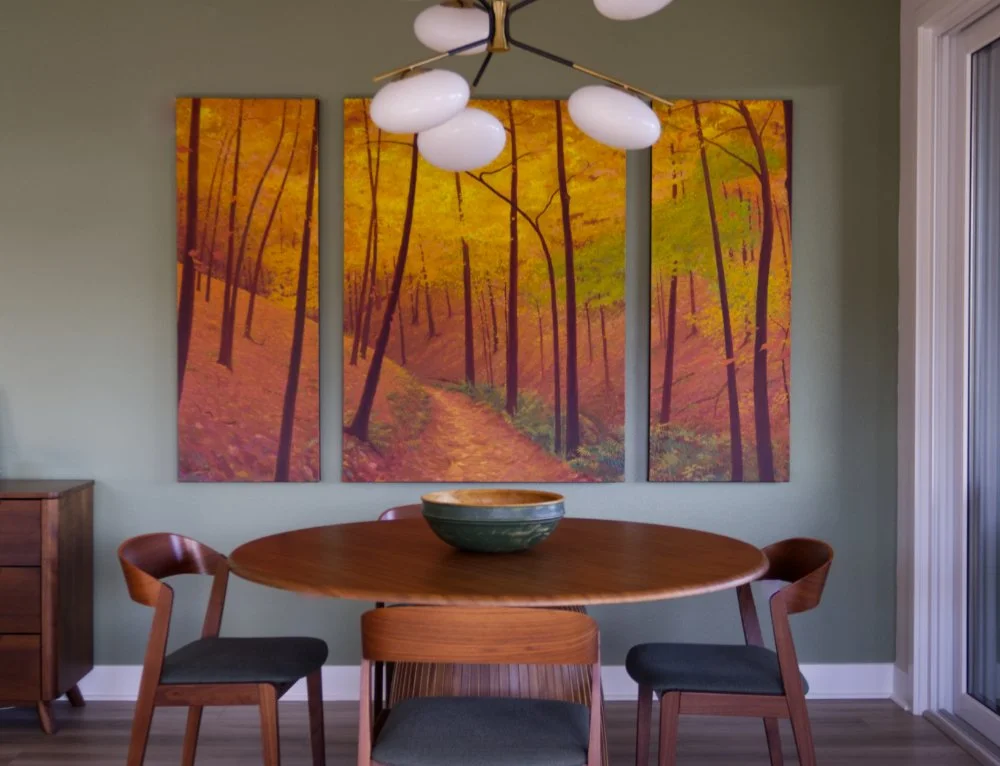
Sylvan Glen in its Seattle home. The triptych creates a warm focal point in the dining area while drawing the eye from throughout the open living space.
Consider Viewing Distance
Large paintings often reveal themselves differently depending upon how far away you are.
Across a room, you first experience the composition: the movement of light, the overall color relationships, and the emotional impression of the landscape.
As you approach, other things begin to happen.
Individual brushstrokes become visible. Unexpected colors emerge. Layers of paint and subtle shifts in texture begin to assert themselves.
That changing experience is one of the qualities I particularly enjoy about large paintings. They can hold a room from a distance while still rewarding someone who walks closer.
When considering a painting, think not only about where it will hang, but also about how people will approach it and the distances from which it will most often be seen.
Allow the Painting Some Breathing Room
It can be tempting to fill a large wall completely, but empty space around a painting is not wasted space.
It gives the artwork room to assert itself.
This is particularly important with paintings that have strong color, movement or scale. Crowding them with numerous smaller objects, furniture or competing artwork can diminish their impact.
Sometimes a single substantial painting on a generous wall creates far more presence than an arrangement of many smaller pieces.
The wall becomes part of the presentation.
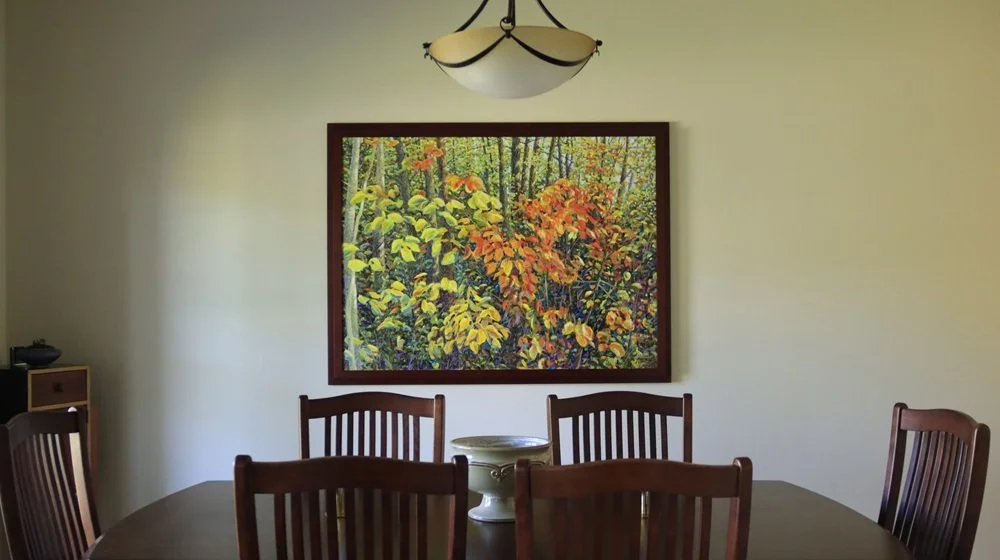
Where Autumn Gathers Light in its Ohio home. The painting gives the dining room a visual center, demonstrating how original art can define a space rather than simply fill a wall.
Think Beyond the Wall Itself
When I helped another collector hang Where Autumn Gathers Light I was reminded again that a painting's effect extends well beyond its frame.
The painting was installed in a dining room in Ohio. Once it was on the wall, the room changed.
What might otherwise have been a space one simply passed through became somewhere the eye wanted to stop. The painting gave the room a visual center—a destination within the home.
That experience is difficult to understand when looking at a painting as an isolated image on a screen.
In a room, scale becomes physical. Color interacts with changing daylight and artificial light. The painting enters into a relationship with furniture, architecture and the movement of people through the space.
That is when a large painting truly begins doing its work.
Choose for the Room You Will Live With—not the Trend You Are Living Through
Interior trends move quickly. Original art does not have to.
If you are considering a significant painting, I think the better question is not whether it perfectly coordinates with the room as it looks today.
Ask yourself whether you want to continue living with the painting.
Does it hold your attention?
Do you find yourself noticing something different each time you look at it?
Does it create a feeling you want in your home?
If the answer is yes, there is a good chance the room can evolve around the artwork rather than the artwork having to accommodate every future change in the room.
A Large Painting Can Define a Space
Ultimately, choosing a large-scale painting isn't about filling square footage.
It is about creating a relationship between art, architecture and the people who live with both.
The right painting can anchor a room without overwhelming it. It can introduce color without needing to match the furnishings. It can pull the eye across an open floor plan, reward close viewing, change throughout the day as the light changes, and remain meaningful long after today's decorating choices have changed.
A large painting occupies a wall.
The right large painting can define a space.
If you are considering an original painting for a significant wall in your home, I invite you to view my currently available works. And if you're uncertain about scale, placement or how a particular painting might work in your interior, I'm always happy to discuss it with you.