
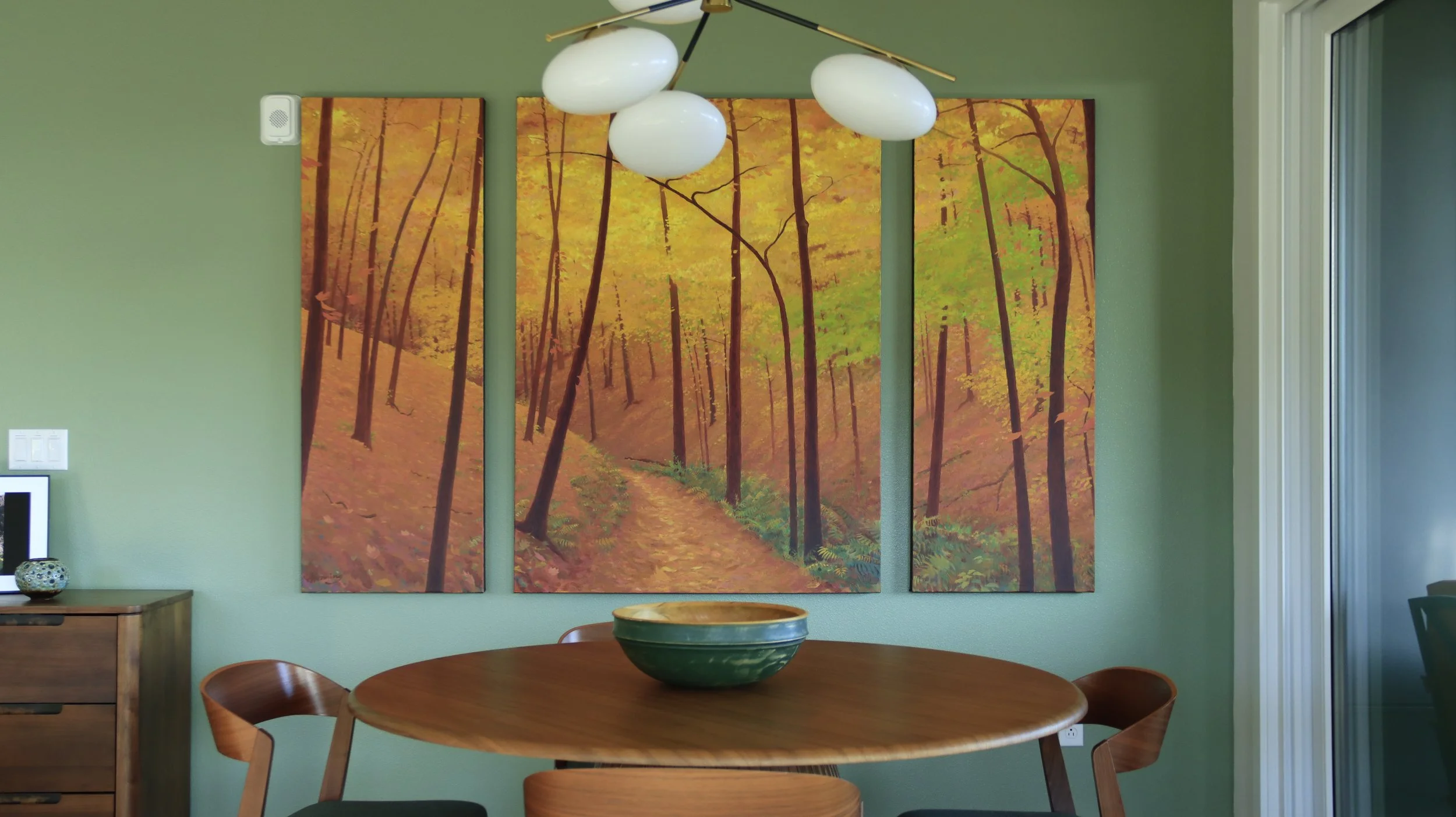
Sylvan Glen brings the color and organic forms of an autumn forest into a contemporary Seattle interior.
Contemporary interiors often emphasize simplicity: clean lines, open spaces, restrained furnishings and walls in white, gray or other neutral colors.
A landscape painting brings something very different into that environment.
Organic forms. Color. Atmosphere. Movement. The suggestion of light, water, trees, grasses and distance.
Perhaps that contrast is precisely why landscape paintings can feel so at home in contemporary spaces.
A Painting Doesn't Have to Match the Room
When people consider a painting for their home, one of the first questions is often whether its colors will work with the furnishings.
That's understandable. But I think there is another question worth asking:
What could this painting bring into the room that isn't there now?
I've had the opportunity to see many of my paintings after they've found their homes, and those installations have taught me something. A successful painting doesn't necessarily need to disappear comfortably into its surroundings. Sometimes it provides the very thing the room is missing.
That might be warmth in an otherwise restrained interior. It might be color, movement or a connection to nature. Or it may simply give the eye a place where it wants to linger.
Bringing Nature Into a Contemporary Space
I saw this particularly clearly with Sylvan Glen, a large landscape triptych installed in a contemporary Seattle condominium.
The home had an open floor plan encompassing the living room, dining area and kitchen. When I first saw the painting installed, it occupied a large white wall and immediately became a warm visual destination within the space.
It could be seen from the sofa, from the dining area and while standing at the kitchen island. The landscape didn't simply fill an empty wall. It gave the eye somewhere to go.
When I saw the home again several months later, the owner had painted the walls a soft gray-green. The relationship changed again. The landscape seemed even more integrated with the room while retaining its role as a focal point.
What struck me most wasn't that the painting "matched." It was the presence it brought into an otherwise highly contemporary environment: color, organic form and the suggestion of a world beyond the walls.
Sometimes Art Changes How a Room Feels
I've seen the same principle work in a very different setting.
My dentist built a beautiful new dental clinic. Everything was fresh and contemporary, but the interior walls were almost entirely white or off-white.
Landscape images changed those spaces immediately.
In the waiting room, a long horizontal landscape above a comfortable sofa introduced warmth and color and created a welcoming focal point. In the treatment rooms, softer waterlily images were positioned where patients could see them from the dental chairs.
I can't claim that a landscape painting makes a visit to the dentist relaxing. I know it doesn't for me.
But I do know how nice it is to have something beautiful and visually engaging to look at when I'd rather not concentrate on the physical situation of the moment. A painting gives the eye somewhere else to go—and, perhaps for a little while, the mind follows.
That is something art can contribute to a professional interior that has very little to do with decoration.
A Landscape Can Also Say, "This Is Where We Are"
Another installation taught me something different about the role landscape painting can play in a public or professional space.
For years, a major regional economic-development organization displayed one of my large landscapes across a prominent wall in its reception area. The painting depicted a quintessential rural scene—recognizably characteristic of the region the organization served.
People arriving from communities throughout the region didn't need an explanation of the painting. They knew that landscape.
And in a very subtle way, I think the painting communicated something on behalf of the organization:
We know who we serve.
That's one of the remarkable qualities of landscape imagery. A landscape can be beautiful without being generic. It can carry associations with geography, seasons, memory and home.
In the right setting, that sense of place can become part of the identity of the room itself.
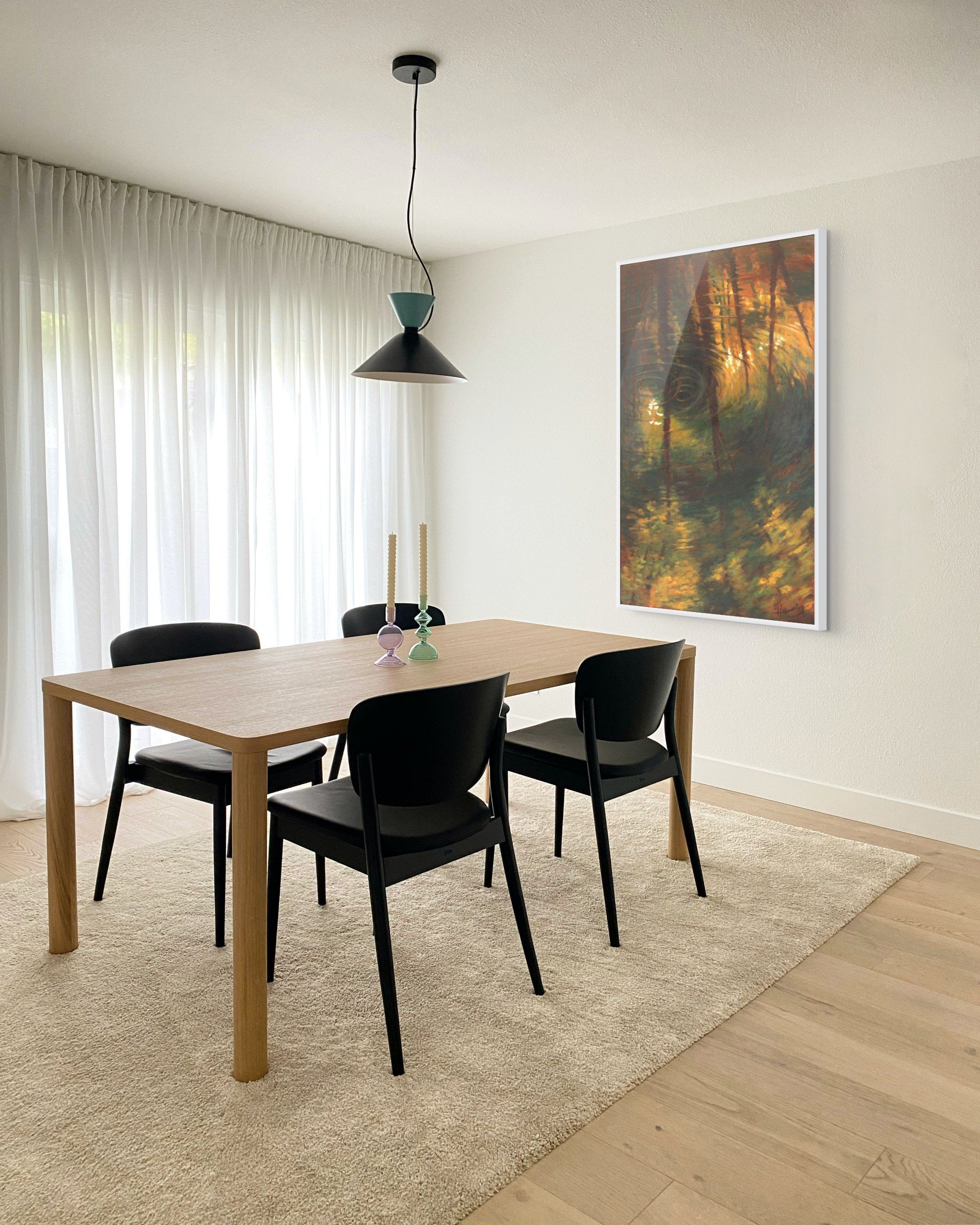
A landscape painting can introduce color, movement and organic form without competing with the clean lines of a contemporary room.
The Contrast May Be the Point
This is why I don't believe a contemporary interior necessarily calls for contemporary abstraction—or that a landscape painting needs rustic surroundings in order to feel appropriate.
Quite the opposite.
The geometry and restraint of a contemporary room can provide an extraordinary setting for the irregularity of nature. Straight architectural lines meet tangled grasses and tree branches. Neutral walls surround chromatic color. Still surfaces contrast with expressive brushwork.
Neither has to imitate the other.
The room provides space for the painting, and the painting brings something living into the room.
Choosing What You Want a Painting to Bring Into the Space
When considering an original painting, dimensions certainly matter. So do viewing distance, furniture placement, sight lines and proportion. I wrote about those practical considerations in How to Choose a Large-Scale Painting for a Room.
But once those questions are answered, I think there is a more personal one:
How do you want this room to feel?
Perhaps it needs energy. Perhaps warmth. Perhaps a sense of quiet.
Maybe you want to be reminded of forests, open prairie, water or distant horizons. Or perhaps you simply encounter a painting that makes you want to keep looking at it—and then begin imagining what it would be like to live with it.
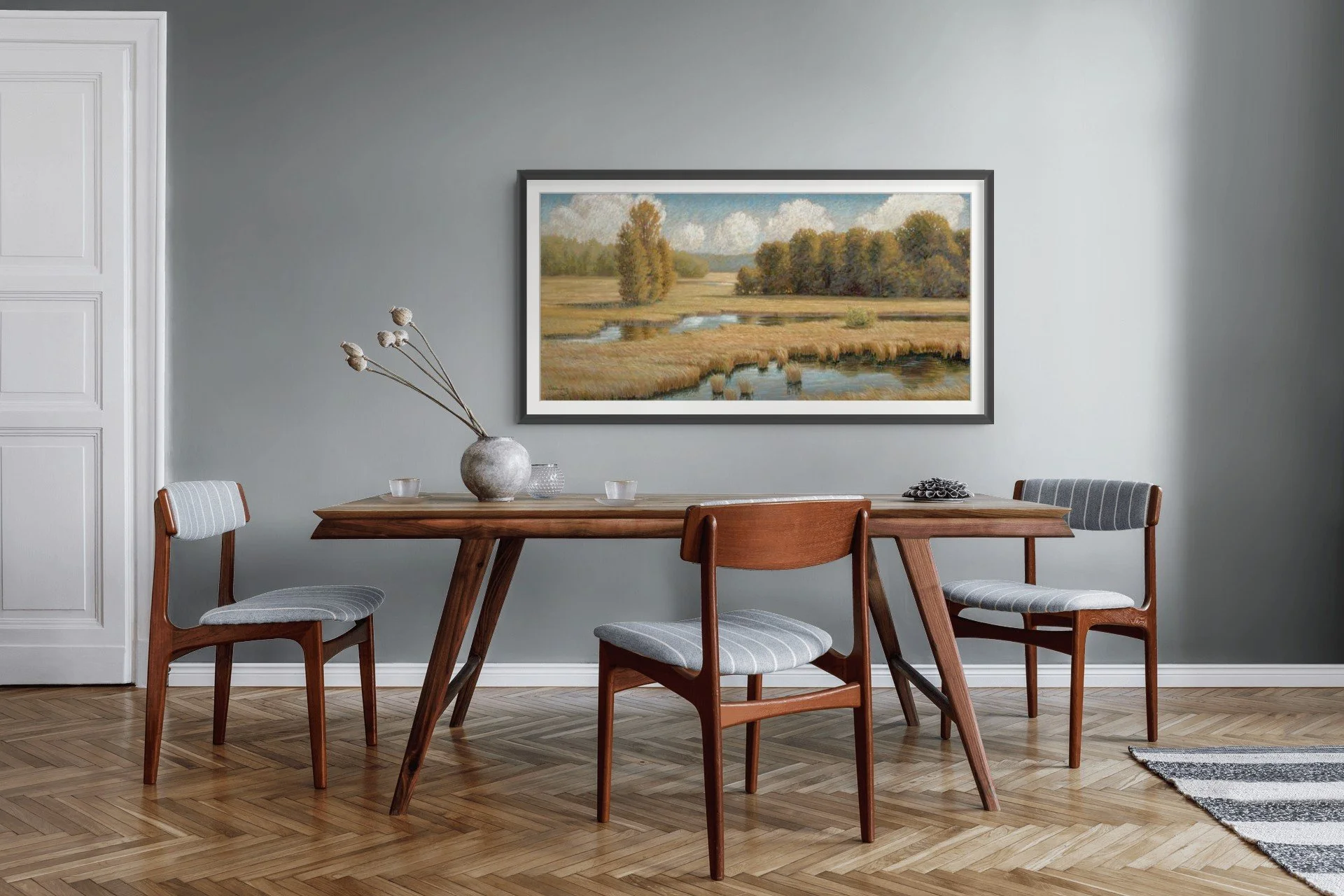
The subject and character of a landscape can influence how a room feels—from the intimacy of a forest to the openness of water, prairie and distant horizons.
A large landscape doesn't simply occupy an empty wall.
At its best, it changes the experience of the room—creating a place for the eye to settle, introducing the presence of nature, and giving the space an emotional center.
Perhaps that is why landscape paintings can feel so unexpectedly at home in contemporary interiors. The contrast isn't something that needs to be resolved. It is often what makes the relationship compelling.
If you're considering an original landscape for a particular space, you can view my currently available paintings or contact me about finding—or creating—a work suited to the room where it will live.